The makers of maps that show the shipwrecks along the South African coast must have struggled to deal with the coast of the Southern Overberg. Between Danger Point to the west and Cape Infanta, the outer eastern point of De Hoop Nature Reserve, about 140 shipwrecks are mapped. Most of these shipwrecks are concentrated around Cape Agulhas, Arniston and Quoin Point.
The history of Quoin Point and its shipwrecks is closely connected to that of Elim, the Moravian mission village on the road between Baardskeerdersbos and Bredasdorp. Over the years, residents of Elim have often provided assistance to victims of shipwrecks. Accounts from 1838 already mention that men and women of Elim collected the valuable cargo of the Duke of Northumberland, a troop ship that stranded near Cape Agulhas. Of the people on board the ship only a few survived. When the Cape Agents of the shipping company arrived, they found that the 38 bodies that were washed ashore had already been interred. Food was brought in from Elim to feed the starving survivors.
After people from Elim provided assistance at the wrecking of the Jessie in 1829 at Quoin Point, Queen Victoria granted the right to use the land at Quoin Point to residents. This was a clever move, since it assured people would be present to assist shipwreck survivors at this treacherous point where shipwrecking was more the rule than the exception. Today there is still a small light-tower surrounded by some cottages owned by the Schipper and October families of Elim.
Originally, Quoin Point was named Ponta de Sao Brandoa by Bartolomeu Dias when he rounded Quoin Point in 1488 on the name day of the Irish monk St. Brendanus. Later the name changed to Quoin Point, but the locals call it Jessie se Punt (Jessie's Point).
The Joanna (Wrecked 1682)
The Joanna was the first English East Indiaman that wrecked on the South African coastline. She was on her way from England to the East when she stranded just east of Quoin Point. Ten people drowned, but a group of 104 reached Cape Town. Rumours of a treasure on board spread through town, causing Governor Simon van der Stel to send the Dutch East India Company official Olaf Bergh to investigate. Bergh found a few bodies, which he buried, but also several bottles of brandy and wine and—more interesting for Bergh's mission—a few hundred Spanish coins. Bergh and his group got onto the wreck of the Joanna and recovered numerous other coins before he returned to Cape Town; mission successfully accomplished. Exactly 300 years after the Joanna went down, her remains were rediscovered. Over 23,000 coins and a few hundred kilograms of silver were salvaged!The Nicobar (Wrecked 1783)
A day of fishing off Quoin Point in 1987 brought good fortune for Louis Groenewald and Wilfred Chivell, both born and bred Gansbaaiers. Hanging over the side of their boat, they spotted something on the ocean floor. They dived down to check it out and found a cannon and a box with money. Back in Gansbaai they realized that they had found the wreck of the Nicobar, a Danish ship with an enormous cargo of copper-plate money. The Nicobar had not been seen since it went down in 1783 taking all aboard, except 11, with her. Louis and Wilfred returned to the wreck and took 4 months to salvage what turned out to be the biggest find of copper-plate money in the world! Chivell, a conservationist, now owns Dyer Island Cruises, organizing whale watching boat tours from Kleinbaai on Danger Point Peninsula.The Doncaster (Wrecked 1836)
The Doncaster was on her way from Mauritius to England when she found her premature last resting place at the mouth of the Ratel River, east of Quoin Point. There were no survivors. Local witnesses described how bodies were continually washed ashore. A man with the name of Hans Aventure (a person described as Khoi) witnessed the ship perish after she had been "ten or twelve days standing in and off the shore before the disaster happened, sometimes so near to shore that the voices of the crew could be heard". The beach was covered with parts of the ship, uniforms of different regiments (some invalid soldiers from Mauritius sent back to England), music, prayer and hymn books. The most curious find was a box with part of a stomach of a soldier which was meant for the Chief Medical Officer in London!The Teuton (Wrecked 1881)
On route from Cape Town to Port Elizabeth, the English steamer Teuton struck a rock off Quoin Point. The rock was known and charted. Although the Teuton was making water, Captain Manning decided that the Teuton could still reach the port of Simon's Town in False Bay. He ordered to man the pumps and ready the lifeboats. Not much later, the propeller came out of the water and the bow went down. Manning ordered to abandon ship. The first lifeboat parted with a lot of laughter and cheering. The second lifeboat was never launched as the Teuton suddenly went down. Captain Manning perished with the ship together with 235 crew and passengers; only 36 in the first lifeboat survived.The Avala (Wrecked 1938)
In 1938, the 17-year-old Samuel Schippers from Elim was catching fish with Herman October and other Elimmers at Quoin Point when he spotted the Avala drifting to shore. While drinking morning coffee, the group of Elimmers watched the Avala go down. The Elim men saw in horror how the two lifeboats headed for a reef, invisible to the crew. The Elimmers made a fire and hoisted a flag on improvised poles to warn them of the dangers ahead and direct them towards a safe landing place. Samuel and his companions helped the shipwreck survivors get their belongings ashore, and Samuel remembered how 22 barrels of wine floated ashore from the wreck!The City of Lincoln (1946) & Salvage Ships Swona & Fynd (1947)
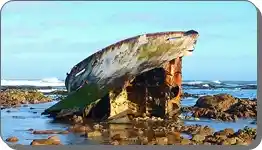
Jan Fourie, famous Gansbaaier and local historian, describes in Duskant die Duine how as a child he witnessed the salvaging of the City of Lincoln: apart from cargo worth 2 million pounds, there were 13 new Dodge and Plymouth cars on board purchased for the 1947 visit of the English Royal family. Several of these cars had been thrown overboard. Jan remembers spotting a car engine in the water years later! A Caterpillar earth-moving machine was salvaged and ploughed local fields for many years. The propellers of two salvage ships, the Swona and the Fynd, got tangled with the cables, and both shared the fate of the City of Lincoln and ended up on the beach. Their remains can still be seen there today!The Esso Wheeling (1948)
The Esso Wheeling wrecked in 1948 at the west side of Quoin Point, and its oil drifted towards Dyer Island, home to tens of thousands of African penguins and seabirds. The oil spill killed an estimated one-third of the penguin colony on Dyer Island, leading to the eventual formation of SANCCOB to care for oiled coastal birds.Le Centaur (Wrecked 1750)
Le Centaur was a French ship carrying 300 crew, 100 passengers and a cargo consisting solely of peppercorns. Bound from Mauritius to France, she ran aground west of Cape Agulhas in 1750. In an orderly fashion, 400 people reached the beach safely. Burdened with supplies, they started a trek of hundreds of miles along precipitous cliffs and loose beaches towards the Castle in Cape Town. Aqua Exploration discovered the wreck in 1984 while searching for treasure: artefacts recovered included a huge bell, a French Double Sol coin, wine onion bottles, a gold earring, and peppercorns everywhere!HMS Birkenhead (Wrecked 1852)
Under Captain Robert Salmond RN, the Birkenhead left Simon's Bay at 06:00 on 25 February 1852 carrying troops from ten different regiments to the Eastern Cape. Shortly before 02:00 on 26 February, travelling at 8 knots in calm seas, she struck an uncharted rock off Danger Point. Salmond ordered the women and children into the ship's cutter. Lieutenant-Colonel Seton of the 74th Foot took charge of the military personnel and stressed the necessity of maintaining order and discipline.When the ship broke in two, Salmond called out that all who could swim should jump overboard and make for the boats. Colonel Seton, recognising that rushing the lifeboats would risk swamping them and endangering the women and children, ordered the men to stand fast—and only three men made the attempt. The soldiers did not move, even as the ship sank barely 20 minutes after striking the rock. This immortal act of heroism gave birth to the maritime protocol: "Women and children first".
Modern Wrecks & The Flying Dutchman
Otori Maru No. 8: Japanese fishing trawler grounded at Shell Point, Bantamsklip in 1984 in dense fog. Still visible. Un Hung: Taiwanese fishing vessel wrecked in 1989 at Pearly Beach. Still visible.Seven shipwrecks surround Danger Point Peninsula and 140 wrecks are dotted between Danger Point and Cape Infanta. Danger Point is also where the legendary phantom ship The Flying Dutchman was recorded in logbooks by Captain Owen on HMS Leven in 1823, and witnessed by the future King George V in 1881.