Exploring the rock pools and driftlines along the Perlemoen Trail brings encounters with extraordinary marine creatures:
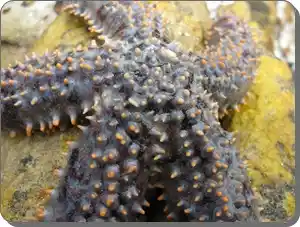
📷 Dark spiny starfish on tidal reef
Spiny Starfish
A voracious predator, particularly of mussels. Starfish have hydraulic tube feet used for locomotion and gripping prey. The feet at the tips of the rays are sensitive to chemicals, enabling the starfish to detect food odours, with eyespots at arm tips responding to light.
Starfish lack a centralized brain, but have a complex nervous system. If one arm detects an attractive odour, it becomes dominant and temporarily overrides the other arms to initiate movement towards prey. Starfish can regenerate lost limbs, and some species can regrow their entire body from a single limb!
Sea Swallow (Glaucus atlanticus)
A nudibranch floating upside-down on the surface water tension, actively hunting bluebottles and employing their stinging cells for its own defence.
Blue Button (Porpita porpita)
Related to bluebottles, but with mild stinging cells that have no effect on humans.
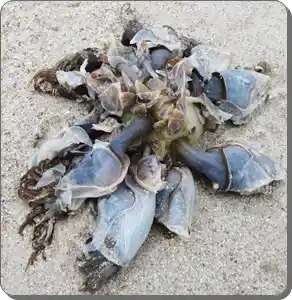
Buoy Barnacle (Dosima fascicularis)
Secretes its own flotation ball from modified cement glands, allowing colonies to drift together across ocean currents.
Bubble-Raft Shell (Janthina janthina)
Violet snail that floats upside down suspended by a raft of mucus-coated bubbles, feeding on siphonophores.
Columbus Crab (Planes minutus)
Pelagic crab hitchhiking on floating kelp and loggerhead turtles.
Sea Spiders (Pycnogonida)
Have four pairs of legs with claw-like ends for holding onto substrates in strong ocean currents.
Hydroids
Colonies of numerous individuals structured like feathery or fern-like polyps.
Basket Star (Euryalida)
A stunning member of the brittlestar group washed ashore in kelp holdfasts, with branching arms growing up to 60 cm across.
Giant Chiton (Dinoplax gigas)
Known as the armadillo of the sea, an eight-plated mollusc found half-buried in sand or rock crevices that grazes on micro-algae at night, returning to its exact hiding scar by topographical navigation.
Crabeater Seal
A rare find indeed—only about 20 ever recorded in South Africa, this lost animal was rescued far from its Antarctic pack-ice home with the help of the Dyer Island Conservation Trust.
About Your Guide
Jason Stonehewer is the founder of Beachcomber Guide and recipient of the Mayor’s Award for Environmental Conservation along the Overberg coastline.
Join Jason and our expert FGASA guides on a guided 4-day, 50 km slackpacking journey along South Africa's stunning Cape Whale Coast. Only 12 exclusive trails hosted each year!