🌟20% discount Oct/Nov 2026 Trail !! 2027 Dates and Spring Whale Watching Open for Booking! Only 12 exclusive trails host per year. View Dates & Availability →
Many species are identified and explained on the Perlemoen Trail. The Khoisan were the first to discover the healing qualities in the various parts of fynbos plants. Much of this knowledge was embraced by the early European settlers; some of this knowledge is still used today with traditional healers and in modern medicine.
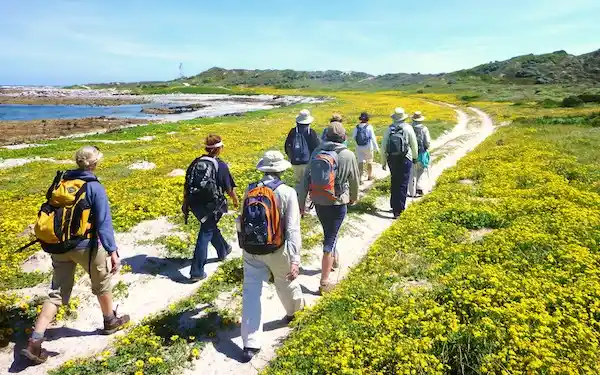
📷 Flowers at Quoin Point in Strandveld fynbos
Wild plants are protected by law and may not be dug up, pulled up, picked or destroyed; rather visit a nursery and plant in your garden. Many plants are poisonous—never eat or use any plant as medicine unless you are 100% sure of correct identification. Consult a doctor before using any plant as a medicine.
Sour Fig (Carpobrotus edulis)
Creeping succulent plants with three-angled fleshy leaves; flowers yellow, ageing pink. Edible fruits used for jams. The leaf juice is a natural antiseptic and traditionally gargled with water to treat mouth and throat infections, also used externally to treat eczema, wounds, burns and blue bottle stings.
Large bush with simple leaves and serrated edges; bright yellow flowers—the only South African daisy that bears berries (black when ripe, arranged in a ring). Sweet edible fruit. The Khoi, Zulu and Xhosa believe the fruit contains blood-strengthening and purifying qualities, used as a tonic when recovering from illness and for male vitality. Berries are said to clear adolescent acne and skin problems. Not to be eaten if suffering from sinusitis.
Pig's Ear (Cotyledon orbiculata)
Stout succulent with large oval ear-like leaves; the stalked hanging tubular flowers have backward-curled petals at the rim. Leaves used to treat corns, boils, warts and fever blisters. Warmed leaf juice used to treat earache. Internal use is dangerous and potentially lethal.
Kooigoed / Everlastings (Helichrysum crispum)
Aromatic perennial herbs or shrublets with silvery grey, densely hairy or woolly leaves and creamy white flower heads. The Khoi used it as a calming tea and to treat heart ailments in stock animals. Said to be a cure for high blood pressure and calming a racing heart. Smoking the leaves was used for pain relief. Leaves used as bedding, pillows or potpourris—said to keep bed bugs away!
Waxberry (Morella cordifolia)
Sprawling shrub up to 1.5 meters high with small heart-shaped leaves with serrated margins closely packed on the stem. The berries are covered with a visible layer of wax (which is in fact a fat). Berries were a food for the Khoi and traded in the early days to the Cape colony to make candles, floor polish, ointments and soap; roots and bark were used medicinally.
Rose-Scented Pelargonium (Pelargonium capitatum)
Velvety-leaved, low-spreading plant with soft stems and perfumed scent. A remarkable skin softener: scented leaves were rubbed into hands to soothe calluses or into heels to soften cracked hard skin. Also used in a bath for skin treatment, and to make a medicinal tea.
Dune Sage (Salvia africana-lutea)
Aromatic shrub growing 2 meters tall with densely packed grey finely hairy leaves, and orange-brown flower clusters at stem ends. Flowers produce copious nectar and are pollinated by sunbirds. Sage makes an excellent tea for coughs, colds, bronchitis and bacterial infections; also used for wounds, skin and scalp problems.
Cape Mistletoe (Viscum capense)
Leafless woody parasite with fleshy jointed stems; berries ripen in spring to a translucent yellow. The whole plant was harvested and taken as a herbal tea—a traditional remedy for asthma, bronchitis and excessive or irregular menstruation. An infusion of the fruit stops haemorrhaging, especially nose-bleeds; also widely used as a herbal tonic and general health tea. Overdose reportedly causes drowsiness.
Tortoise Berry (Muraltia spinosa)
Spiny shrub growing 1 meter high sparsely covered with small, narrow leaves; numerous pink to purple flowers produce round fleshy red fruit. Popular thirst-quenching snack rich in vitamin C. An infusion made with the leaves is used for colds and flu; stems are included for a bitter digestive tonic, a general remedy for TB and abdominal pains.
Much-branched shrublet up to 800 mm with bright orange-red berries during summer. Whole plant used medicinally: the Khoi used it as a purgative and to treat boils and haemorrhoids. A decoction of the whole plant is taken as a blood purifier for acne, sores and boils; the bitter plant causes perspiration and sleepiness. Also used as a component in the Italian aperitif Campari!
White Milkwood (Sideroxylon inerme)
Densely leafy shrub or rounded tree 10 meters tall with oval shiny green leaves and stems that bleed a milky latex; small greenish-white flowers produce fleshy purple-black fruits. Medicinally the bark was used in infusions to dispel bad dreams, and the decoction used for gall sickness in stock animals. The pulpy edible fruits are best when dried because of sticky latex. The close-grained, durable wood was used for wagon work—now strictly protected.
Wild Dagga (Leonotis leonurus)
Shrub growing 2 meters high with lance-shaped leaves and bright orange tubular flowers clustered in whorls at intervals along the stem. Medicinally the leaves and stem were smoked as a mild relaxant; leaves and root are widely used to treat snakebite and other bites and stings, along with high blood pressure, asthma, coughs and colds.
Arum Lily (Zantedeschia aethiopica)
Tuberous perennial with long heart-shaped leaves and a snowy white spathe-like flower. Only edible if cooked; fresh leaves cause severe swelling of tongue and throat. The Khoi made a dish called Hottentot bread from the roasted root. Large leaves were warmed and used as plasters for wounds and sores (not to be crushed, as fresh juice causes irritation).
About Your Guide
Jason Stonehewer is the founder of Beachcomber Guide and recipient of the Mayor’s Award for Environmental Conservation along the Overberg coastline.
Join Jason and our expert FGASA guides on a guided 4-day, 50 km slackpacking journey along South Africa's stunning Cape Whale Coast. Only 12 exclusive trails hosted each year!